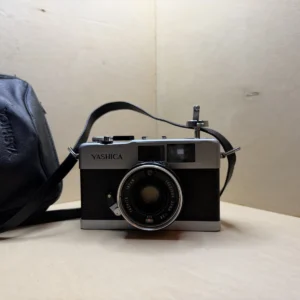
Manual scanned and put online free of charge by Mike Butkus, whose library runs on donations. The link opens his model page, where you can download the PDF.
Getting started
Batteries Push the battery cover catch in the direction of the arrow and lift the cover. Put in two 1.5 V AA alkaline batteries as shown in the compartment diagram, then close it. The manual rules out Ni-Cd rechargeables and lithium batteries.
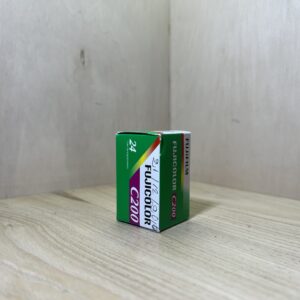
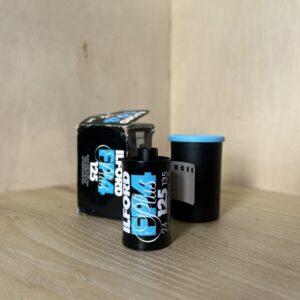
Film Push the slider down to open the back, insert the cartridge at an angle from the top, pull the film leader to the mark and lay it over the take-up spool. Close the back firmly: the film advances by itself to 1 on the counter, otherwise open it again and start over. It reads the DX code of ISO 100, 200, 400 and 800 films, and treats a film without a DX code as ISO 100.
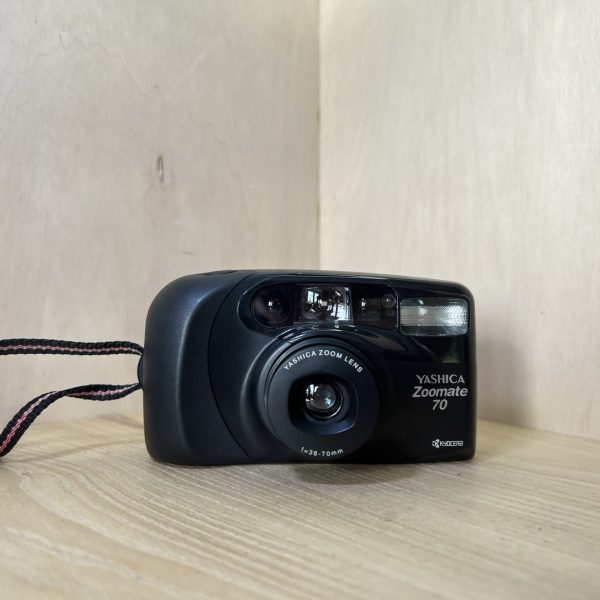
Getting started Press the main switch: the lens cover opens and the lens extends. The green LED near the eyepiece blinks while the flash charges and goes out when it’s ready. Left unused for about 3 minutes, it switches itself off to save the batteries.
Your first photo Frame with the zoom button, towards W for wide angle or T for telephoto. Put the focus frame, in the centre of the viewfinder, on your subject and press halfway: the green LED lights up when it’s sharp. Then press all the way, or step back if it blinks: you’re too close.
Rewinding After the last frame, it rewinds by itself and the counter counts down the frames. Wait for the 0 to blink before opening the back and taking out the cartridge. To rewind mid-roll, press the manual rewind button, without using a sharp object.
What it can do
The mode button cycles through six settings, shown on the LCD: auto flash (the default mode), auto flash with red-eye reduction, fill-in flash, fill-in flash with red-eye reduction, flash off and landscape.
Focus lock: aim at the subject with the central frame, press halfway, keep your finger in place and reframe, then press all the way. Releasing the shutter button cancels the lock.
Landscape mode, for a distant subject or a view through a window: the flash doesn’t fire, and the camera returns to auto flash by itself after the shot.
Self-timer of about 10 s: put the camera on a tripod, aim and press the self-timer button. The lamp blinks and the counter shows the seconds remaining. Pressing again cancels it.
On date back versions, it prints the date or time in the bottom right corner of the photo: year-month-day, month-day-year, day-month-year or day-hour-minute. This back has its own CR2025 lithium battery.
The flash
In auto, it fires by itself when there isn’t enough light. With ISO 100 film, it reaches from 1.1 to 4 m at 38 mm, and from 1.1 to 2 m at 70 mm.
Red-eye reduction: a lamp lights up about 1 second before the flash. Keep the camera still, and your subject too, until the flash fires.
Fill-in flash: it fires on every shot. Use it against the light, in front of a window or on the beach. In dim light, a slow shutter speed also keeps the ambient light.
After each flash, the green LED blinks while it recharges, about 6 s, and the shutter button stays locked.
Flash off, for a sunset or an interior: the shutter speed gets slow in low light, so rest the camera on a tripod or a steady support.
Good to know
The battery symbol on the LCD tells you it’s time to change the batteries. If they weaken further, the display goes off and the camera stops working.
The autofocus can be fooled by smoke, water, shiny bodywork, fur, a window in between or a very small subject. In that case, lock focus on an object at the same distance.
Hold it with both hands, flash at the top for a vertical photo, with no finger or wrist strap in front of the lens or the flash.
While the zoom is moving, the shutter button doesn’t work.
In cold weather, batteries weaken: keep the camera under your coat and take it out at the last moment.
Care
Clean the lens with lens tissue moistened with cleaning fluid and remove dust with a blower brush. Clean the body with a soft cloth, never with thinner or benzine.
After the seaside or dusty places, clean it thoroughly. Don’t leave it in the heat for long, for example in a closed car in the sun.
It contains high-voltage circuits: if it breaks down, don’t open it yourself.
If you won’t use it for a long time, take out the batteries: they could leak.
Zoomate 70 specifications
Format
35 mm film, automatic loading, advance and rewind
Lens
38-70 mm zoom, f/5.2 at 38 mm and f/9.1 at 70 mm, 5 elements in 5 groups
Shutter
electronic leaf shutter
Focusing
autofocus with focus lock, from 1.1 m to infinity
Exposure
programmed auto exposure, EV 5 to 16 at ISO 100
Sensitivity
ISO 100, 200, 400 and 800 by DX code, ISO 100 without DX code
Viewfinder
zoom, Albada type with bright-line frame
Flash
built-in, recycles in about 6 s, range 1.1 to 4 m at 38 mm and 1.1 to 2 m at 70 mm (ISO 100)
Power
2 × 1.5 V AA alkaline batteries, about ten 24-exposure rolls with half the shots on flash
Dimensions and weight
129 × 72 × 47.5 mm, about 245 g without batteries (about 50 mm and 250 g with date back)
Pay by card, Klarna or Google Pay. Your bank details never pass through us.
Free delivery from €150 in mainland France
Elsewhere, the exact rate is shown before you pay.
Tracked parcels, padded by hand
Tracking number by email, oversized packaging: a camera body doesn’t travel like a book.
Tested second-hand
Mechanics, optics, electronics: every item goes through our testing method before it goes online.
A word about cookies
Those for the basket and payment are essential. The others wait for your consent: audience measurement, advertising, visit tracking for our emails. You can withdraw it whenever you like. Details here.