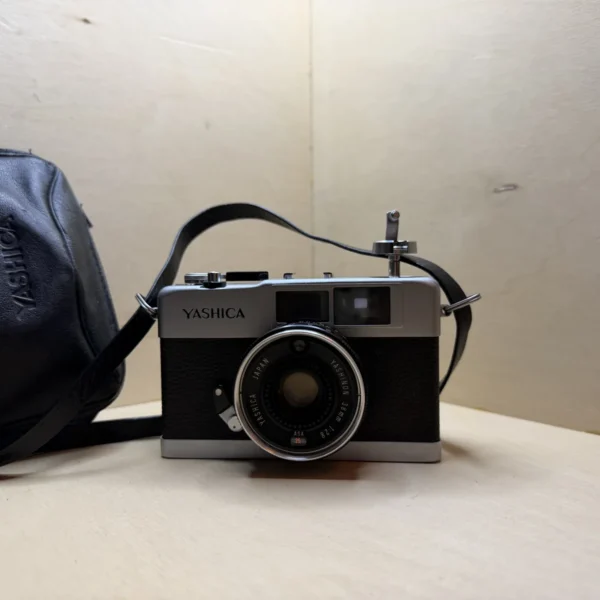
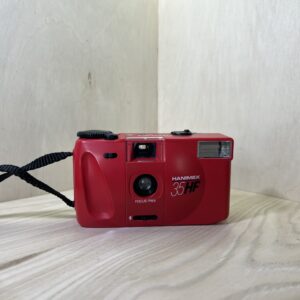
Manual scanned and put online free of charge by Mike Butkus, whose library runs on donations. The link opens his model page, where you can download the PDF.
Getting started
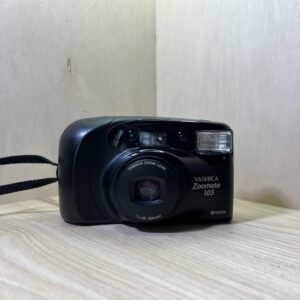
Battery Open the battery compartment cover, under the body, by turning it anticlockwise with a coin. Slide in a 1.3 V mercury battery (Eveready EP-675E, Mallory RM-675R or equivalent), negative pole first, and put the cover back on. Aim at a bright area: if the viewfinder needle stays still, change the battery.
Loading Out of direct sunlight, pull the rewind knob all the way out: the back opens and the counter returns to S. Put in the cartridge, push the knob back in, slide the film leader into a slot in the take-up spool and wind it on with the advance lever. Close the back when the teeth engage the perforations on both edges, then alternate lever and shutter button until the counter reads 1.
Sensitivity Turn the ASA film speed ring until your film’s value shows in its window, from ISO 25 to 400 (ASA). Make sure it stops on a click: the automatic exposure depends on it.
Your first photo Turn the Auto ring to put the AUTO mark opposite the index line. Turn the focusing ring to the symbol that matches the distance (portrait, group, landscape): it also appears in the viewfinder. If the needle, on the right of the viewfinder, stays in the yellow zone, take the picture.
Rewinding After the last frame, don’t force the lever: the film could tear. Press the release button under the camera, unfold the crank and turn it in the direction of the arrow, past the slight resistance, until it turns freely. Then open the back.
What it can do
Programmed shutter: the CdS cell chooses the shutter speed and aperture combination by itself, from 1/30 s at f/2.8 up to 1/650 s at f/14 (ISO 100). You frame, you focus, you shoot.
In the viewfinder, the needle shows the chosen shutter speed and aperture, inside a bright-line frame. At 1.5 m or closer, frame your subject within the parallax correction mark.
Focusing by four symbols or by the distance scale, in metres and feet, engraved on the lens opposite the symbols. It goes down to 1 m.
8 s self-timer: wind the advance lever, push the self-timer lever all the way in the direction of the arrow, then press the shutter button.
The flash
Hot shoe with X contact: the flash connects to it without a cord.
With flash, move off the AUTO position: turn the Auto ring until your flash’s guide number is opposite the index line. The shutter then switches to 1/25 s. Don’t use the flash on AUTO.
With the Yashica MS-14DX (guide number 14 at ISO 100, in metres), set 14 and the 3 m focus symbol: from 2.5 to 5 m, the subject is sharp and well exposed. With a different film, a table in the manual gives the setting.
If the needle falls into the underexposure zone, switch to flash.
Good to know
If the needle rises into the overexposure zone (beach, snow), screw on a 46 mm ND filter. The cell is covered by the filter: no correction needed. Only one filter at a time.
The Butkus page notes that the camera takes mercury batteries. In normal use, the manual reckons on a year and a half per battery. Put the lens cap back on when you’re not using it.
If it’s put away for a while, take out the battery and keep it somewhere cool and dry. Wipe its terminals with a dry cloth before putting it back. Don’t open a mercury battery or throw it into a fire.
To check that the film is advancing, gently turn the rewind crank clockwise until you feel slight resistance: with each advance, the knob then turns the other way.
35-ME specifications
Format
35 mm film in a standard cartridge
Lens
Yashinon 38 mm f/2.8, 4 elements in 3 groups, 59° angle of view
Shutter
programmed, from 1/30 to 1/650 s, 1/25 s with flash, self-timer
Metering
CdS cell above the lens, fully automatic exposure, from EV 8 (f/2.8 at 1/30 s) to EV 17 (f/14 at 1/650 s) at ISO 100
Sensitivity
ISO 25 to 400 (ASA)
Focusing
four zone symbols, visible in the viewfinder, or distance scale, 1 m at the closest
€25.00Original price was: €25.00.€21.50Current price is: €21.50.
Secure payment
Pay by card, Klarna or Google Pay. Your bank details never pass through us.
Free delivery from €150 in mainland France
Elsewhere, the exact rate is shown before you pay.
Tracked parcels, padded by hand
Tracking number by email, oversized packaging: a camera body doesn’t travel like a book.
Tested second-hand
Mechanics, optics, electronics: every item goes through our testing method before it goes online.
A word about cookies
Those for the basket and payment are essential. The others wait for your consent: audience measurement, advertising, visit tracking for our emails. You can withdraw it whenever you like. Details here.