





Nikon F50: manual and user guide
A 35 mm autofocus SLR with an F mount and a built-in flash. Its original manual, then the essentials for using it.
View the manual on butkus.orgOriginal scanned manual · 72 pages · in English and German
Manual scanned and put online free of charge by Mike Butkus, whose library runs on donations. The link opens his model page, where you can download the PDF.
Getting started
- Battery With the camera off, slide the battery compartment lock to open it. Insert a 6 V 2CR5 or DL245 lithium battery, with + and − placed as shown inside the lid, then close it until it clicks. Turn on: the display shows “E” or the frame number, with no battery symbol.
- Loading Slide the back lock to open it, insert the cartridge and pull the film leader to the red mark. Check that the film lies flat and that the sprocket holes engage the teeth, then close: the film winds on by itself to frame 1. If the counter stays on “E”, load the film again.
- Sensitivity With DX-coded film, the film speed sets itself, from ISO 25 to 5000. With non-coded film, in ADVANCED mode, the ISO setting display appears when you close the back: set it with the buttons above ▲ and ▼, then confirm with the one above ISO. Until it’s confirmed, the shutter button stays locked.
- Your first photo Turn the lens aperture ring to the highest value, in orange on AF Nikkors, and lock it: otherwise Err blinks. Set the focus mode selector to AF, the switch to ON and the dial to ADVANCED: as it leaves the factory, that’s the general-purpose program. Place the focus brackets on the subject and press halfway: autofocus and metering start, and focus stays locked as long as you keep pressing. Release the shutter: the film winds on one frame by itself.
- Rewinding At the end of the roll, the motor rewinds by itself and the counter counts down the frames. To rewind before the end, press the rewind button, under the body. Don’t open the back in direct sunlight.
What it can do
- Two ways to use it: SIMPLE, all in program (general-purpose, landscape, portrait, close-up), and ADVANCED, which adds the sport, silhouette, night scene and motion effect programs, shutter priority, aperture priority and manual.
- Single autofocus by default: focus stays locked as long as you press halfway, which lets you reframe. In ADVANCED, continuous autofocus follows moving subjects.
- In the general-purpose program, the buttons above ▼ and ▲ shift the shutter speed and aperture combination, and P* appears. The original combination comes back when you turn off, switch to SIMPLE or use the flash.
- In ADVANCED, exposure compensation of ±5 EV in half steps and Time exposure (T). Exposure lock with the AE-L button, 10 s self-timer.
Which lenses?
- Nikon F mount. It is made for AF Nikkor lenses, except those designed for the F3AF: AF Nikkor 80 mm f/2.8, ED 200 mm f/3.5 IF and the TC-16/TC-16A converter.
- With an AF-I or AI-P Nikkor, set the selector to M and focus with the ring.
- AI Nikkors without contacts also fit, in manual mode only and with a handheld light meter. The aperture isn’t displayed: you set it on the ring. In the other modes, the shutter button is locked.
- The manual warns that lenses not on its list can damage the camera.
The flash
- When light is low, the lightning bolt blinks in the viewfinder at half-press. Press the flash release to pop it up and activate it. It also works with backlit subjects, to fill in the shadows.
- Guide number 13 in metres at ISO 100, covers the field from 35 mm, sync at 1/125 s or slower.
- Don’t fire it more than 20 times in a row at intervals of 5 s or less, then let it rest for at least 10 minutes. Don’t touch it while it fires: it gets hot.
- With a Nikon flash on the hot shoe, keep the built-in flash down, otherwise the external flash won’t fire.
Good to know
- The battery symbol blinks: battery nearly flat. “Err” and the symbol blink together: turn off and change the battery. Blank display: battery flat or wrongly inserted.
- A new battery lasts about 100 rolls of 24 exposures without flash at 20 °C, and 20 with flash on every other shot. At −10 °C, expect 40 and 13. Measured with the AF 35-80 mm f/4-5.6 D zoom.
- In severe cold, use a new battery and keep the camera warm. Take the battery out if you won’t be using it for a long time.
- Load and unload film out of direct sunlight, especially fast film. Opening the back resets the counter to “E”.
F50 specifications
- Format
- 135 film, 24 × 36 mm frames
- Mount
- Nikon F, for AF Nikkor lenses
- Shutter
- vertical-travel focal-plane, electronically controlled, from 30 s to 1/2000 s, Time exposure (T) in ADVANCED
- Focusing
- single or continuous autofocus, and manual, autofocus range from −1 to 19 EV at ISO 100
- Metering
- matrix in program, shutter priority and aperture priority, centre-weighted in manual, from 1 to 20 EV at ISO 100 with an f/1.4 lens
- Sensitivity
- ISO 25 to 5000 automatic with DX, ISO 6 to 6400 by hand for non-coded film (ADVANCED)
- Viewfinder
- fixed pentaprism, about 90% coverage, 0.78× magnification with a 50 mm lens
- Flash
- built-in TTL, guide number 13 (m, ISO 100), sync at 1/125 s or slower, hot shoe with TTL contact
- Power
- 6 V 2CR5 or DL245 lithium battery
- Dimensions and weight
- 149 × 96 × 70 mm, about 580 g without battery
In the shop
The Nikon F50 in the workshop
Filter
Showing the single result

Goes well with
Complete your kit
Accessories in stock that travel in the same parcel.
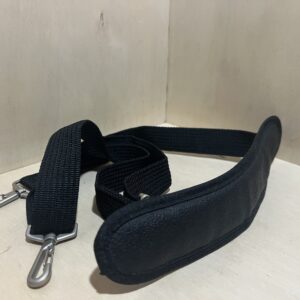
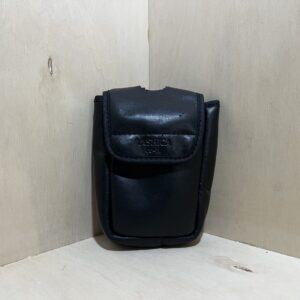
In the same category
The same kind of camera, available
More items from the same category, tested and checked in our workshop.
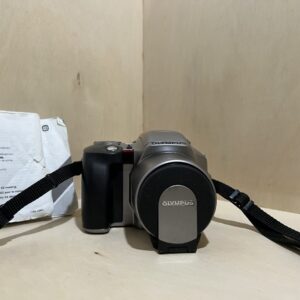
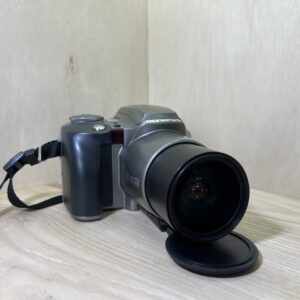
Olympus IS300 – Gris
Original price was: €75.00.€62.00Current price is: €62.00.
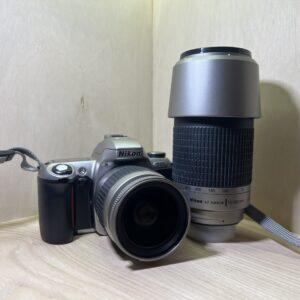
Nikon F65 + 2 objectifs – Beige
Price range: €115.00 through €235.00