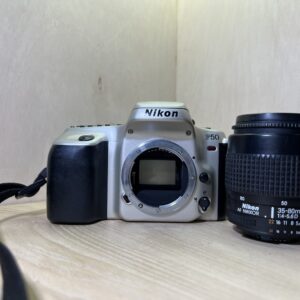
Manual scanned and put online free of charge by Mike Butkus, whose library runs on donations. The link opens his model page, where you can download the PDF.
Getting started
Batteries Set the camera to OFF, open the battery compartment lid and slide in two CR123A or DL123A lithium batteries, + and – terminals as shown in the lid. Turn the power back on: a full battery symbol means the voltage is sufficient. If it blinks, change both batteries.
Lens With the power off, line up the marks on the lens and the body, then turn the lens anticlockwise until it locks. Set its ring to the smallest aperture (the highest f-number) and lock it: otherwise FEE blinks and the camera refuses to fire.
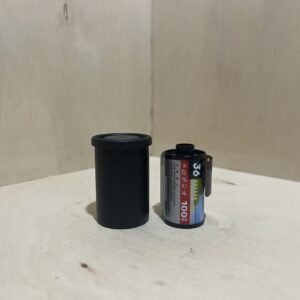
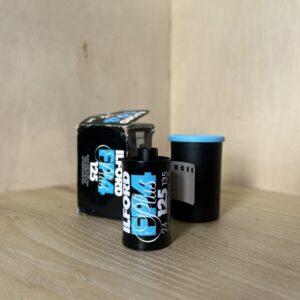
Loading With the power on, open the back, slide the cartridge in from the bottom and pull the film leader to the red mark, film taut. Close the back gently: the film winds on by itself to the first frame and the counter shows 1. Use DX-coded film: it reads the film speed by itself, from ISO 25 to 5000.
Your first photo Set the mode dial to AUTO, with autofocus. Press halfway and wait for the in-focus indicator in the viewfinder, then slowly press the shutter button all the way. The film moves on to the next frame by itself. If the lightning bolt blinks in the viewfinder, pop up the built-in flash.
Rewinding At the end of the roll, it rewinds by itself and the counter counts down. When E appears and the film symbol blinks, open the back out of the sun and take out the cartridge by tilting it. To rewind before the end, press the rewind button with a pointed object.
What it can do
Five modes: AUTO, P with program shift, S (shutter priority), A (aperture priority) and M, plus five Vari-Programs: portrait, landscape, close-up, sport and night scene.
Shutter speeds from 30 s to 1/2000 s, and Time exposure (T) in M mode.
Exposure compensation from -3 to +3 EV in half steps in P, S, A and M, and an AE-L button to lock exposure.
In Sport mode, it keeps shooting as long as you hold the shutter button down, at about 1 frame per second.
A 10 s electronic self-timer, which you can cancel.
The flash
The built-in flash pops up when you press its release button. Guide number 15 (at ISO 100, in m), it covers the field of a 28 mm lens or longer, with films from ISO 25 to 800.
Four modes: normal, red-eye reduction, slow sync, slow sync with red-eye reduction. Sync up to 1/125 s.
Remove the lens hood before using the flash. Some zooms limit flash use and can cause vignetting.
If the lightning bolt blinks about 3 s after the shot, the photo may be underexposed: check the flash range and try again.
The hot shoe takes an external flash, with contacts for TTL flash.
Which lenses?
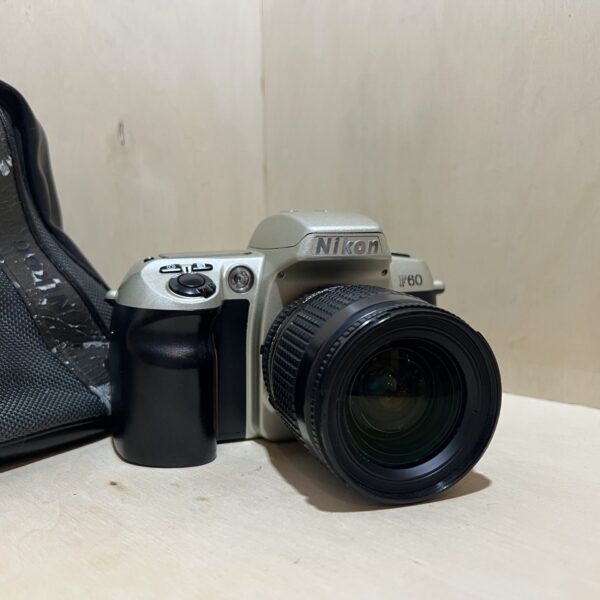
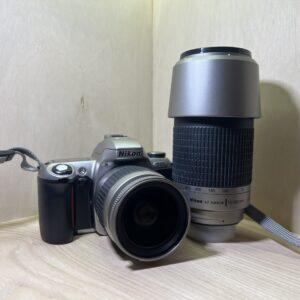
Nikon F mount, with restrictions depending on the lens.
With a D-type AF Nikkor, everything works: autofocus, all modes, 3D matrix metering. A non-D AF Nikkor keeps autofocus, with six-segment matrix metering.
According to the manual, AF-S and AF-I Nikkors fit but don’t autofocus on this body: manual focus.
Manual AI, AI-S and Series E Nikkors fit with manual focus, in M mode only and without the exposure indicator. Without a CPU lens, F– blinks outside M mode.
IX-Nikkor lenses don’t fit.
Good to know
It only accepts DX-coded film. With non-coded film, the film symbol blinks and E appears.
To see the film speed read from the film, press the exposure compensation and aperture buttons together. More than two seconds, and all settings go back to their defaults.
The shutter curtains are fragile: don’t touch them with your finger or with the film leader.
Weak batteries or severe cold: rewinding may stop and Err blinks. Turn the power off, change the batteries, turn it back on and restart the rewind.
A set of new batteries lasts about 65 rolls of 36 exposures without flash at 20 °C, about 16 if you take half the shots with flash. Always change both batteries together, of the same brand.
F60 specifications
Format
135 film, 24 × 36 mm frames
Mount
Nikon F
Shutter
vertical-travel focal-plane, electromagnetically controlled, 30 s to 1/2000 s, Time exposure (T) in M mode
Focusing
TTL phase-detection autofocus with AF-assist illuminator, or manual
Metering
3D matrix (D-type AF Nikkor), six-segment matrix (non-D AF Nikkor), centre-weighted in M and with AE-L, 1 to 20 EV
Sensitivity
ISO 25 to 5000, automatic via DX code
Viewfinder
fixed pentaprism, about 90% coverage, dioptre adjustment from -1.5 to +1
Flash
built-in, guide number 15 (ISO 100, m), sync up to 1/125 s, ISO hot shoe with TTL contacts
Power
two CR123A or DL123A lithium batteries
Dimensions and weight
about 148.5 × 96 × 69 mm, about 575 g without the batteries
Pay by card, Klarna or Google Pay. Your bank details never pass through us.
Free delivery from €150 in mainland France
Elsewhere, the exact rate is shown before you pay.
Tracked parcels, padded by hand
Tracking number by email, oversized packaging: a camera body doesn’t travel like a book.
Tested second-hand
Mechanics, optics, electronics: every item goes through our testing method before it goes online.
A word about cookies
Those for the basket and payment are essential. The others wait for your consent: audience measurement, advertising, visit tracking for our emails. You can withdraw it whenever you like. Details here.