Manual scanned and put online free of charge by Mike Butkus, whose library runs on donations. The link opens his model page, where you can download the PDF.
Getting started
Batteries Set the switch to OFF, slide the cover lock and insert two 3 V CR2 lithium batteries the way marked in the compartment. Always change both at once, new and of the same brand.
Loading Turn the camera on, open the back with its lever and slide the cartridge in from the bottom. Pull the film leader to the red mark, no further, film taut, without touching the shutter curtains. Close the back: the film winds on by itself and the display shows “1”.
Sensitivity Nothing to set: with DX-coded film, the camera reads the film speed by itself, from ISO 25 to 5000. It can’t be set by hand, and film without a DX code is treated as ISO 100.
Your first photo Set the focus mode selector to AF and the mode dial to AUTO. With an AF lens that has an aperture ring (not a G type), lock the ring at the smallest aperture, otherwise “FEE” blinks and the shutter button stays locked. Press halfway to focus, wait until the in-focus indicator stays steady in the viewfinder, then press gently all the way.
Rewinding At the end of the roll, rewinding starts by itself. When “E” blinks on the counter, it’s done: open the back, out of direct sunlight. To rewind before the end, press both rewind buttons at the same time for about 1 s.
What it can do
Autofocus with a choice of five areas, and an AF-assist illuminator that reaches from about 0.5 to 3 m. Setting the selector to M switches to manual focus.
A mode dial: AUTO, five subject programs (portrait, landscape, close-up, continuous sport, night), then P, S, A and M.
Shutter speeds from 30 s to 1/2000 s, in half steps in S and M, and a “Time” exposure in M.
Exposure compensation of ±2 EV in half steps (not in M or AUTO), three-frame bracketing and multiple exposure in P, S, A and M.
A 10 s self-timer, and about 2.5 frames per second in sport mode with new batteries.
Good to know
Without a DX code, the camera exposes for ISO 100, whatever the speed of your film.
Infrared films won’t work: an infrared sensor detects the position of each frame.
If “Err” and “E” blink after you close the back, the film is wrongly loaded: open it again and reload, lining up the leader with the red mark.
With two new CR2 batteries at 20 °C, the manual reckons on about 50 rolls of 36 exposures without flash, 10 if the flash and the illuminator are used on every other shot. At −10 °C, about 25 and 7.
If rewinding doesn’t start or stops partway (weak batteries, cold), turn the camera off, change the batteries, turn it back on and press both buttons again for about 1 s.
Which lenses?
The mount is the Nikon F bayonet, with AF coupling and contacts. With the camera off, line up the marks on the lens and the body, then turn anticlockwise until it locks, without touching the release button.
A D-type or G-type AF Nikkor gives 3D matrix metering. A G type has no ring: the aperture is chosen on the body.
Other AF Nikkors and AI-P lenses give six-segment matrix metering. In M mode, the camera switches to centre-weighted metering by itself.
Lenses without a CPU (AI, AI-S, Series E) fit, but with manual focus and in M mode only, without the light meter. IX-Nikkors don’t fit.
The flash
The built-in flash pops up by itself in AUTO and in the subject programs, except in continuous sport, where it isn’t used. In P, S, A and M, press its release button.
Guide number 12 (ISO 100, m). It covers a 28 mm lens or longer and works with films from ISO 25 to 800.
X-sync up to 1/90 s. Modes: normal sync, slow sync, rear-curtain sync, red-eye reduction (alone or with slow sync), and flash cancelled.
The hot shoe has TTL contacts for an optional Nikon flash: remove its cover first.
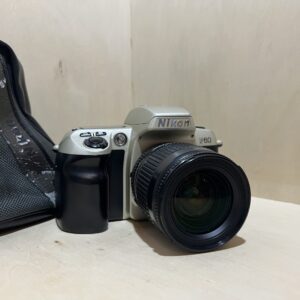
F65 specifications
Format
135 film, 24 × 36 mm frames
Mount
Nikon F bayonet, AF coupling and contacts
Shutter
vertical-travel focal-plane, electronically controlled, from 30 s to 1/2000 s, “Time” exposure in M
Focusing
phase-detection autofocus (Multi-CAM900 module), five areas, AF-assist illuminator from about 0.5 to 3 m, or manual
Viewfinder
fixed pentaprism, about 89% coverage, dioptre correction from −1.5 to +0.8 dioptre
Metering
through the lens, at full aperture: six-segment 3D matrix, six-segment matrix or centre-weighted, from EV 1 to EV 20 (ISO 100, f/1.4)
Sensitivity
ISO 25 to 5000 via DX code, ISO 100 for film without a DX code
Flash
built-in, guide number 12 (ISO 100, m), X-sync up to 1/90 s, TTL hot shoe
Power
two 3 V CR2 lithium batteries, or optional MB-17 grip with four AA batteries
Dimensions and weight
about 139.5 × 92.5 × 65.5 mm and 395 g without batteries (F65D: 68 mm deep, 400 g)
Pay by card, Klarna or Google Pay. Your bank details never pass through us.
Free delivery from €150 in mainland France
Elsewhere, the exact rate is shown before you pay.
Tracked parcels, padded by hand
Tracking number by email, oversized packaging: a camera body doesn’t travel like a book.
Tested second-hand
Mechanics, optics, electronics: every item goes through our testing method before it goes online.
A word about cookies
Those for the basket and payment are essential. The others wait for your consent: audience measurement, advertising, visit tracking for our emails. You can withdraw it whenever you like. Details here.