Manual scanned and put online free of charge by Mike Butkus, whose library runs on donations. The link opens his model page, where you can download the PDF.
Getting started
Battery Turn the battery compartment cover anticlockwise until it stops, without forcing. Insert a Mallory PX-13 battery, + facing outwards, then put the cover back. It powers the light meter.
Loading In dim light, out of the sun, pull the latch up, open the back, unfold the crank and pull up the rewind knob. Put the cartridge in, push the knob back down and slide the film leader into the slot of the take-up spool, with the sprocket teeth in the perforations. Close the back, wind on and fire twice, then, with the shutter cocked, set the counter’s 0 opposite the index.
Sensitivity Turn the film speed dial to set your film’s value opposite the index. It is marked from 16 to 500 GOST: the table in the manual pairs ISO 100 (ASA) with 90 GOST, 200 with 180 and 400 with 350. The small divisions between the figures give the intermediate values.
Your first photo Wind on as far as it goes, set the lens aperture lever to A and focus. With your eye to the viewfinder, press the shutter button until you feel resistance and turn the aperture ring or the shutter speed dial until the needle meets the index. Then press all the way, smoothly: a jerky movement gives a blurred image.
Rewinding At the end of the roll (36 exposures), turn the rewind release ring, around the shutter button, as far as it goes. Unfold the crank and turn the knob in the direction of the arrow until the film leaves the take-up spool, then pull up the knob, open the back and take out the cartridge. Finally, turn the ring back clockwise to its starting position.
What it can do
Through-the-lens metering: it stays accurate with another lens, a colour filter, a close-up lens or extension rings.
A needle in the viewfinder: towards the + sign, the exposure is too high, towards the minus sign, it is too low. If it doesn’t meet the index at any setting, change the lighting or use a film of a different speed.
An automatic aperture: on A, it stays open for viewing and only closes when the shutter fires. On M, it closes as soon as you turn the ring.
A depth-of-field preview: on A, press the shutter button until you feel resistance and look at the ground-glass circle. On M, look at it without pressing. The lens scale also gives it: focused at 3 m at f/8, the image is sharp from 2.3 to 4.5 m.
A self-timer: with the camera on a tripod, cock the shutter, push the self-timer lever down as far as it goes, switch the aperture to M, then press the self-timer button. It fires after at least 7 s.
Which lenses?
An M42 × 1 screw mount, with a 45.5 mm flange distance: the manual provides for interchangeable lenses with this thread.
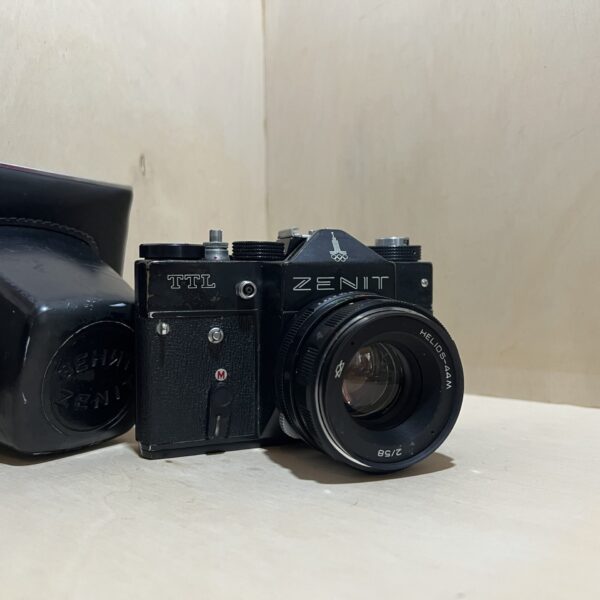
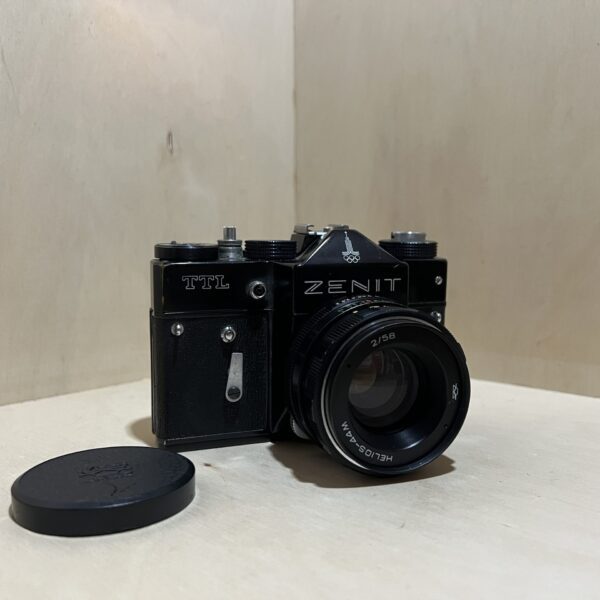
The manual describes the Helios-44M 58 mm f/2: aperture from f/2 to f/16, focus from 0.55 m to infinity, M52 × 0.75 screw-in filters. The small R mark on the scale is for infrared film.
A lens without an automatic aperture is set by hand. With a long focal length, the left and right edges of the negative may be cut off.
For copy work and close-up photography, extension rings fit between the body and the lens. Without a pusher pin, set the aperture lever to M.
The flash
The X sync takes any electronic flash, with the shutter speed dial on 1/30 s.
The flash cord plugs into the body’s sync socket.
The French manual also provides a cordless contact on the shoe, under a protective bar to remove first. The English manual only describes an accessory shoe and the cord: check whether the shoe on your body has a contact.
Good to know
Never set the shutter speed dial between B and 500, or the film speed dial in an area without figures.
Always wind on as far as it goes, in two or three short strokes of the lever, otherwise you lose frames. Don’t leave the camera cocked for long: it can harm the shutter.
On B, the shutter stays open as long as you press. For a longer exposure, turn the pressed shutter button to the left as far as it goes, then the other way to finish, with a cable release screwed into the button and the camera on a tripod.
Below -10 °C, don’t leave it out: keep it under your coat and take it out for the shot. Store it in its closed case, lens cap on, shutter and self-timer uncocked.
Don’t touch the lens elements with your fingers and only wipe their outer surfaces, with a soft cloth or cotton barely moistened with alcohol or ether. Clean the mirror and the Fresnel lens with a dry brush, without liquid.
TTL specifications
Format
135 film, 24 × 36 mm frames, 36 exposures
Mount
M42 × 1 screw, 45.5 mm flange distance
Lens
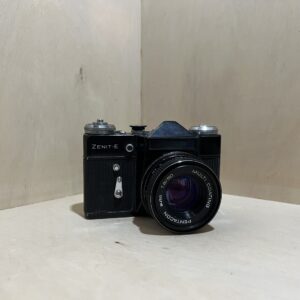
Helios-44M 58 mm f/2, automatic or manual aperture from f/2 to f/16, focus from 0.55 m to infinity, M52 × 0.75 screw-in filters
Shutter
1/30 to 1/500 s, Bulb and long exposure, self-timer, at least 7 s
Focusing
manual, central microprisms and ground-glass circle, on a Fresnel lens
Metering
semi-automatic TTL light meter, needle in the viewfinder
Sensitivity
16 to 500 GOST, i.e. ISO 16 to 500 (ASA) according to the table in the manual
Flash
X sync for electronic flash at 1/30 s, sync socket and shoe
Pay by card, Klarna or Google Pay. Your bank details never pass through us.
Free delivery from €150 in mainland France
Elsewhere, the exact rate is shown before you pay.
Tracked parcels, padded by hand
Tracking number by email, oversized packaging: a camera body doesn’t travel like a book.
Tested second-hand
Mechanics, optics, electronics: every item goes through our testing method before it goes online.
A word about cookies
Those for the basket and payment are essential. The others wait for your consent: audience measurement, advertising, visit tracking for our emails. You can withdraw it whenever you like. Details here.