




Minolta XG-1: manual and user guide
Minolta’s aperture-priority SLR, for MD lenses. Its original manual, then the essentials for using it.
View the manual on butkus.orgOriginal scanned manual · 57 pages · in English, French and German
Manual scanned and put online free of charge by Mike Butkus, whose library runs on donations. The link opens his model page, where you can download the PDF.
Getting started
- Batteries Under the body, unscrew the battery compartment cover anticlockwise with a coin. Fit two 1.5 V alkaline or silver oxide batteries (Eveready EPX-76/S-76 or equivalent), + side facing out, and screw it back on fully. Push the switch to “B.C.”: the red lamp on the front lights up if the batteries are good.
- Loading In subdued light, pull the back release knob to open the back, put the cartridge in with the spool end down and push the knob back in. Slip the film leader into a slot in the take-up spool, wind on gently until the teeth catch the perforations on both sides, then close the back. Wind on and fire until “1” on the counter: a red bar should appear to the left of the film transport indicator window, otherwise start again.
- Sensitivity Lift the ring of the shutter speed dial and turn it until your film speed shows in the window, then let go: it stays put. The scale runs from ISO 25 to 1600 (ASA). The dots between the numbers mark the intermediate values.
- Your first photo Set the switch to “ON” and turn the shutter speed dial to “A”, where it locks. Choose the aperture on the lens ring: an LED in the viewfinder shows the shutter speed the camera chooses. Focus and shoot. If the overexposure or underexposure warning lights up, change the aperture.
- Rewinding When the film advance lever locks, don’t force it: the film has probably run out. Press the rewind release button under the body, unfold the crank and turn in the direction of the arrow until the red bar leaves the window and the slight resistance disappears. Pull the back release knob all the way up and take out the cartridge.
What it can do
- Aperture-priority auto exposure: you choose the aperture, it sets the shutter speed steplessly from 1 s to 1/1000 s. In manual, you can use any speed from 1 s to 1/1000 s, plus B.
- Exposure compensation in auto: press the “AUTO” lock and move the selector’s “A” from −2 to +2 EV, in 1/2 EV steps. Put it back on “A” afterwards, as auto exposure doesn’t work outside this range.
- An electronic self-timer of about 10 s: switch to “SELF-TIMER”, then press the shutter button. The lamp blinks, faster in the last 2.5 seconds.
- In the viewfinder: a split image surrounded by microprisms, the shutter speed shown by LED and two warnings for over- and underexposure.
- The Auto Winder G attaches under the body and advances the film at 2 frames per second.
Good to know
- The shutter button is touch-sensitive: simply touching it with your finger turns on the meter and the LEDs. With gloves on or dry fingers, light pressure is enough.
- The shutter won’t fire if the switch is on “OFF”, if the batteries are low or if there is too much light for auto exposure: the overexposure warning tells you so.
- Don’t use 1.3 V Eveready EPX-675 batteries: they are the same shape. A set of batteries lasts about a year. Take them out if the camera won’t be used for more than two weeks.
- In severe cold, around −10 °C, the manual recommends silver oxide batteries and a spare set.
- If your eye isn’t against the eyepiece (tripod, remote release), fit the eyepiece cap: light coming in through it throws off the metering.
Which lenses?
- Minolta bayonet mount: full-aperture metering and full auto exposure with MD and MC lenses.
- The manual lists four standard MD lenses: 45 mm f/2, 50 mm f/1.7, 50 mm f/1.4 and 50 mm f/1.2.
- With an Auto Rokkor, an RF mirror lens or a preset lens, metering is done stopped down. The 35 mm f/2.8 Shift CA, the Auto Bellows I and some Auto Rokkors don’t work in auto.
- To mount the lens, line up the red dots and turn clockwise until it clicks. To remove it, hold the release button down and turn the other way.
The flash
- A direct-contact hot shoe and a PC socket, with X sync.
- An electronic flash syncs from 1 s to 1/60 s and on B, never faster than 1/60 s. M, MF and FP bulbs sync at 1/15 s or slower.
- Minolta X-series Auto Electroflashes, once charged, set the shutter to 1/60 s by themselves. An LED then blinks next to the “60” in the viewfinder.
XG-1 specifications
- Format
- 135 film in cartridges, 24 × 36 mm frames
- Mount
- Minolta bayonet (54° rotation), MD and MC lenses at full aperture
- Shutter
- electronically controlled horizontal focal plane, from 1 s to 1/1000 s (stepless in auto), B
- Viewfinder
- pentaprism, 93% coverage, 0.87× magnification with a 50 mm at infinity
- Focusing
- matte Fresnel screen, diagonal split image surrounded by microprisms
- Metering
- through the lens, at full aperture, two CdS cells, centre-weighted, auto exposure from EV 2 to EV 17 (ISO 100, f/1.4 lens)
- Sensitivity
- ISO 25 to 1600 (ASA)
- Flash
- direct-contact hot shoe and PC socket, X sync at 1/60 s
- Power
- two 1.5 V alkaline or silver oxide batteries (Eveready EPX-76/S-76 or equivalent)
- Dimensions and weight
- 52 × 88 × 138 mm, 490 g without lens or batteries
In the shop
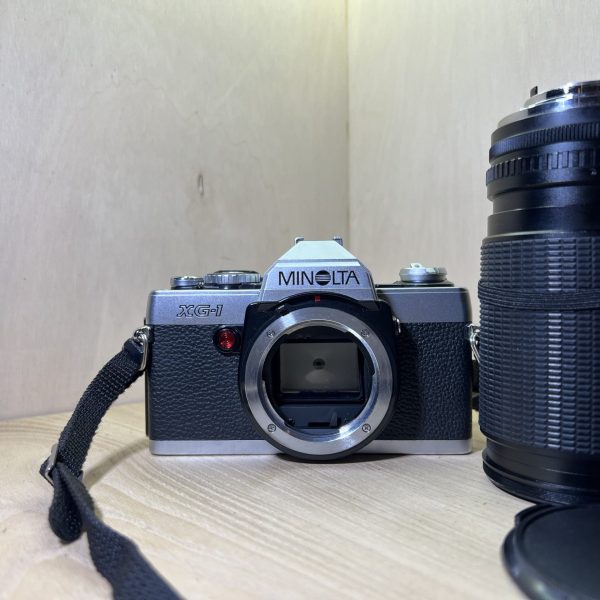
The Minolta XG-1 in the workshop
Filter
Showing the single result
Goes well with
Complete your kit
Accessories in stock that travel in the same parcel.
In the same category
The same kind of camera, available
More items from the same category, tested and checked in our workshop.