




Minolta X-300: manual and user guide
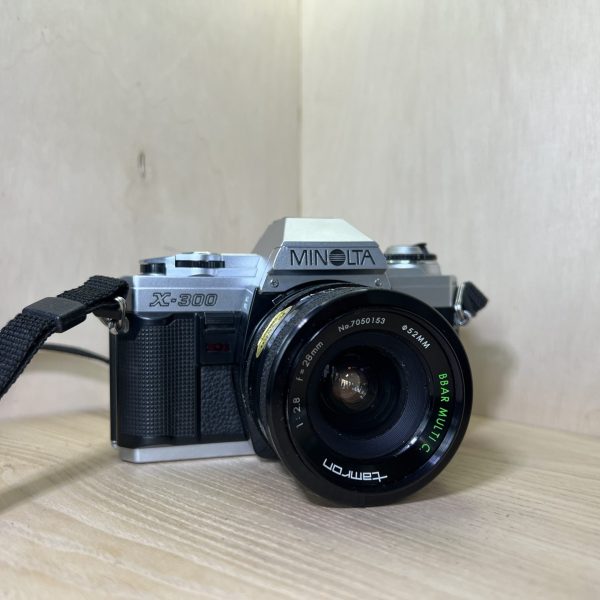
Minolta’s SLR with aperture priority and a manual mode. Its original manual, then the essentials for using it.
Manual scanned and put online free of charge by Mike Butkus, whose library runs on donations. The link opens his model page, where you can download the PDF.
Getting started
- Batteries Unscrew the battery cover anticlockwise with a coin. Slip two LR44 (alkaline) or SR44 (silver oxide) batteries, or one 3 V CR-1/3N lithium battery, + side up, into the holder in the cover, then screw it back on fully. With the switch on ON, lightly touch the shutter button: if the A or the M blinks in the viewfinder, have new batteries ready.
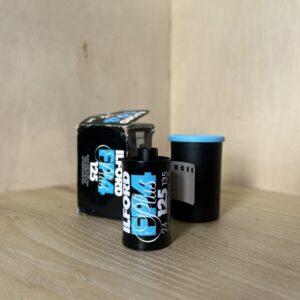
- Sensitivity Press the lock on the film speed ring and turn the ring until your film’s ISO value is against the mark: it locks when you release the lock. The ring goes from ISO 12 to 3200. Slide the end flap of the film box into the memo holder on the back to remember it.
- Loading Unfold the rewind crank and pull it up: the back opens. Put the cartridge in, spool end down, away from direct light, push the knob back in, slip the film leader into a slot in the take-up spool, perforations on the teeth, wind on until the film is taut and close the back: a red S appears on the counter. Wind on and fire until frame 1: a red bar should appear to the left of the loading indicator, otherwise start again.
- Your first photo Selector on AUTO, choose the aperture on the lens: the camera sets the shutter speed by itself, shown by an LED on the right of the viewfinder. Focus until the two halves of the image line up in the centre. Press the shutter button slowly and steadily, never with a sharp jab.
- Rewinding At the end of the roll, don’t force the lever when it locks. Press the rewind button under the body, then turn the crank in the direction of the arrow until it turns freely and the red bar leaves the window on the left. Only open the back when no red can be seen in it any more.
What it can do
- In AUTO, you choose the aperture and it sets the shutter speed steplessly, from 4 s to 1/1000 s. If two LEDs light up, the speed is between the two.
- In manual, from 1 s to 1/1000 s: the blinking LED shows your speed, the steady LED the one the meter reads. Make them match with the aperture ring or the selector, without leaving it between two click stops.
- Exposure lock, in AUTO and without the self-timer: with the subject filling the frame, press the AE lock lever all the way and hold it down, reframe and shoot. Useful against the light or on snow and sand.
- 10 s self-timer: raise the lever, then press the shutter button. The LED on the front blinks twice a second for 8 s, then 8 times a second, then stays lit. Put the lever back afterwards, otherwise the next shot will also go off 10 s late.
- On B, the shutter stays open as long as you press, up to about 10 hours with new batteries at a moderate temperature. The self-timer doesn’t work on B.
Which lenses?
- Minolta bayonet mount: full-aperture metering works with Minolta MD and MC lenses.
- Line up the red mark on the lens with the one on the body, push in and turn clockwise until it clicks. To remove it, press the release button and turn the other way.
- On a recent MD lens, unlock the minimum aperture lock before using it.
- With a lens made by a brand other than Minolta, the manual asks you to check with test shots that it works properly.
The flash
- Direct-contact hot shoe, X sync. With a Minolta X-series flash (118X, 200X), the shutter speed switches to 1/60 s by itself and the 60 LED blinks in the viewfinder when the flash is charged, except on B.
- With another electronic flash, set the selector to 60, or slower for a deliberate effect. Never faster than 1/60 s.
Good to know
- With the switch on ON, lightly touching the shutter button turns on the meter and the viewfinder LEDs for 15 s. With gloves on, press lightly. Put the switch back to OFF after use to avoid firing by accident.
- In AUTO, if the LED at the bottom of the scale blinks, open up the aperture. If the one at the top blinks, stop it down. An LED at 1/30 s or slower warns of a risk of blur: open up further, or use a tripod or a flash.
- No 1.35 V mercury batteries (MR44): same size, but the voltage is too low. Don’t mix types, brands or batteries of different ages.
- In cold weather, fit new batteries and keep a spare set warm. Around 0 °C and below, choose silver oxide: with a lithium battery, the camera may stop working.
- With the self-timer, a cable release or on B, slide the eyepiece cap onto the viewfinder: light coming in through it would throw off the metering.
X-300 specifications
- Format
- 135 film, 24 × 36 mm frames
- Mount
- Minolta bayonet, full-aperture metering with MD and MC lenses
- Modes
- aperture priority (AUTO) and manual with LEDs (M)
- Shutter
- horizontal-travel focal plane, quartz-controlled, 4 s to 1/1000 s in AUTO, 1 s to 1/1000 s and B in manual
- Metering
- through the lens, centre-weighted average, silicon cell, EV 1 to 18 at ISO 100 with an f/1.4 lens
- Sensitivity
- ISO 12 to 3200, in 1/3 EV steps
- Viewfinder
- fixed pentaprism, 95% of the image, 0.9× magnification with a 50 mm, split-image rangefinder, microprisms and Acute Matte screen
- Flash
- X-sync hot shoe, automatic 1/60 s with Minolta X-series flashes
- Power
- 2 LR44 or SR44 batteries, or one 3 V CR-1/3N lithium battery
- Dimensions and weight
- 137 × 90 × 51.5 mm, 470 g without lens or batteries
In the shop
The Minolta X-300 in the workshop
Filter
Showing the single result
Goes well with
Complete your kit
Accessories in stock that travel in the same parcel.
In the same category
The same kind of camera, available
More items from the same category, tested and checked in our workshop.