Official Pentax PDF, which Pentax no longer publishes: the link opens the copy kept by the Internet Archive’s Wayback Machine.
Getting started
Battery With the camera off, open the battery cover with the protruding part of the strap lug. Insert a 3 V CR123A or DL123A lithium battery following the + and − signs in the compartment, then close it until it clicks: the lens moves slightly and the motor runs for a few seconds.
Sensitivity Nothing to set with DX-coded film: it reads the film speed by itself, from ISO 25 to 3200. The manual rules out film without DX coding, which it treats as ISO 25. It recommends ISO 400, and ISO 800 or faster for indoors or low light.
Loading With the camera off, push the back release lever down. Drop in the cartridge, pull the film leader to the film tip mark, keep the film flat between the guides and close the back: the film advances by itself to 1 on the frame counter. If E blinks, reload the film.
Your first photo Press the switch: the lens extends to 38 mm and its cover opens. Frame with the zoom lever, put the autofocus frame in the centre of the viewfinder on the subject and press halfway: the green lamp next to the eyepiece lights up when the image is sharp and the flash is ready. Then press all the way, gently.
Rewinding After the last frame, the lens retracts and the film rewinds by itself, leader included: about 20 s for a 24-exposure roll. When E blinks, open the back in the shade and lift the cartridge out from the top. For a partly used roll, push in the rewind button with the protruding part of the strap lug.
What it can do
A 38-95 mm zoom on the zoom lever, with four stops: 38, 60, 75 and 95 mm. Let go partway, and it stops at the nearest one. The shutter won’t fire while the lens is moving.
The mode button cycles through seven settings: auto, flash on, slow shutter without flash, slow sync, backlight compensation, Bulb without flash and Bulb with flash. Each time you switch on, it goes back to auto.
Backlight compensation of +1.5 EV, for a portrait in front of a window or a bright sky. In a dark place, the shutter speed can drop very low: put it on a tripod.
Bulb keeps the shutter open as long as you hold the shutter button down: for fireworks or a night shot, always on a tripod. With the flash, it’s for a portrait in front of a night scene.
The AF/infinity/drive button gives you the self-timer (about 10 s: the front lamp stays lit for 7 s, then blinks for 3 s. Pressing the switch cancels it) and infinity-landscape mode, flash off, cancelled after one shot.
The flash
In auto, it fires by itself when there isn’t enough light. Charging takes about 7 s: the green lamp and the lightning-bolt symbol blink and the shutter button stays locked. Let go of the button for a few seconds, then try again.
Range with colour negative film: 0.8 to 3.8 m at 38 mm and 0.8 to 1.7 m at 95 mm with ISO 100. 0.8 to 7.5 m and 0.8 to 3.4 m with ISO 400.
Flash on for a face against the light or in the shade, staying within range. Slow shutter without flash where flash isn’t allowed, such as a theatre or museum, or to keep the ambient light.
Slow sync lights the subject with the flash and gives the dark background time to register. The shutter speed drops: a tripod is recommended.
To reduce red-eye, press the eye button: the front lamp lights up about 1 s before the flash fires. Press again to cancel.
Good to know
Focus from 0.8 m to infinity. Any closer and the green lamp blinks: step back until it stays lit. Closer than 1 m, frame within the close-up mark in the viewfinder.
For an off-centre subject, aim at it with the autofocus frame, press halfway, reframe without letting go, then press all the way. Do the same on an object at the same distance if the subject fools the autofocus: very dark, wire mesh, neon light or screen, window glass or car bodywork, fast subject, water, smoke or flame.
Left on and unused for 3 minutes, it retracts the lens and switches itself off. Switch it off in a bag: an accidental press on the shutter button drains the battery.
On the date version (QUARTZ DATE), the DATE, SELECT and ADJUST buttons on the back set and choose the imprint, up to 2049. Opening the cover or removing the battery erases the date: set it again after every battery change.
It isn’t waterproof: wipe it straight away if it gets rained on. It works from −10 to 50 °C. In the cold the battery weakens for a while, then gets its strength back at room temperature.
Espio 95S specifications
Format
DX-coded 135 film, 24 × 36 mm frames, motorised loading, film advance and rewind
Lens
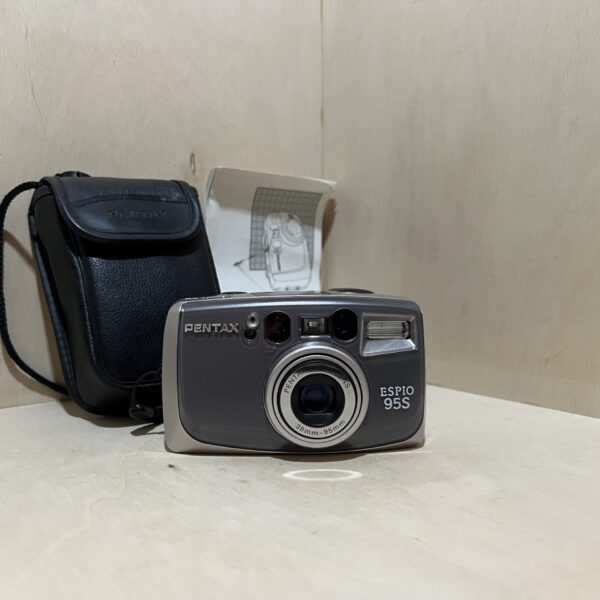
Pentax 38-95 mm power zoom, f/4.5-10, 5 elements in 5 groups, four positions (38, 60, 75 and 95 mm)
Shutter
electronic leaf shutter, programmed auto, about 1/360 to 1/2 s, bulb
Focusing
active infrared autofocus, from 0.8 m to infinity, focus lock at half-press, infinity-landscape mode
Metering
programmed auto, at ISO 400, EV 10 to 17.3 at 38 mm and EV 13.3 to 19 at 95 mm, backlight compensation +1.5 EV
Viewfinder
real-image zoom, 83% coverage, 0.42× magnification at 38 mm and 0.93× at 95 mm, close-up marks
Sensitivity
ISO 25 to 3200 via DX coding, ISO 25 without coding
Flash
built-in, charges in about 7 s, auto, on, slow sync, bulb with flash, red-eye reduction, 0.8 to 7.5 m at 38 mm with ISO 400
Power
one 3 V CR123A or DL123A lithium battery: about 15 rolls of 24 exposures, with flash on half the shots
Dimensions and weight
120.5 × 70.5 × 53.5 mm, 245 g without battery, date version 120.5 × 70.5 × 56 mm, 250 g
€95.00Original price was: €95.00.€72.00Current price is: €72.00.
Secure payment
Pay by card, Klarna or Google Pay. Your bank details never pass through us.
Free delivery from €150 in mainland France
Elsewhere, the exact rate is shown before you pay.
Tracked parcels, padded by hand
Tracking number by email, oversized packaging: a camera body doesn’t travel like a book.
Tested second-hand
Mechanics, optics, electronics: every item goes through our testing method before it goes online.
A word about cookies
Those for the basket and payment are essential. The others wait for your consent: audience measurement, advertising, visit tracking for our emails. You can withdraw it whenever you like. Details here.