Minolta’s official PDF, which it no longer publishes: the link opens the copy kept by the Internet Archive’s Wayback Machine.
Getting started
Battery It runs on a 6 V 2CR5 lithium battery. Slide the door tab, lift the edge of the cover, put the battery in following the marks in the compartment and snap the cover shut. Close the lens cover before removing the old battery.
Loading Open the lens cover, check that the counter shows “0”, then open the back, out of direct sunlight. Put the cartridge in, lay the film flat between the rails and pull the leader to the orange mark. Close the back: the film advances by itself to “1”. If “0” blinks, start again.
Sensitivity Nothing to set: it reads the film’s DX code, from ISO 50 to 3200. A film without a DX code is set to ISO 100. 72-exposure cartridges and Polaroid 35 mm instant films won’t work.
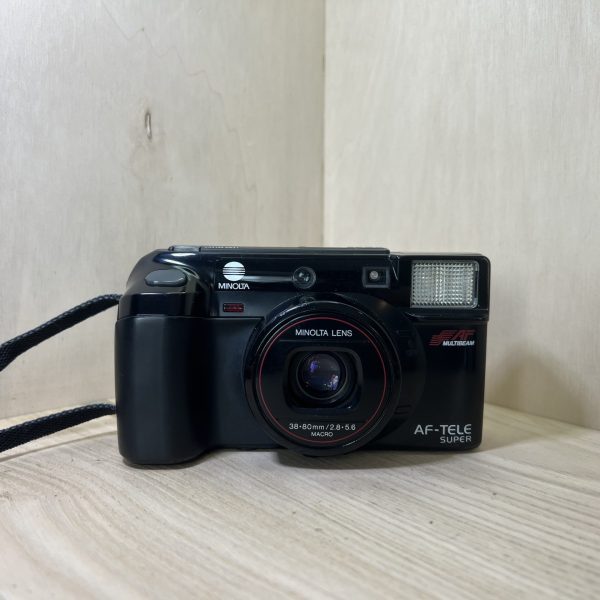
Your first photo Open the cover: the camera switches on at 38 mm, and the selector button switches to 80 mm then back to 38 mm. Put the subject in the viewfinder’s autofocus area and press halfway. When a green lamp lights up, press all the way: the flash fires by itself if needed.
Rewinding At the end of the roll, it rewinds by itself and the counter counts down. When the motor stops and the “film loaded” mark blinks, open the back and take the film out. To rewind before the end, press the rewind button under the camera with the tip of a ballpoint pen.
What it can do
Two lenses: a 38 mm f/2.8 for groups and landscapes, an 80 mm f/5.6 for portraits. The viewfinder frame and the flash coverage follow the chosen lens automatically.
Focusing works from 0.7 m to infinity, with no special setting.
Focus lock, for a subject outside the autofocus area: aim at it, press halfway, reframe without letting go, then press all the way. Exposure is locked at the same time.
It also helps with subjects that fool the autofocus (bright light, water, mirror, flame, hair, dark object, glass): focus on another object at the same distance.
A 10 s self-timer: press its button, the symbol appears, then press all the way. The front lamp blinks until the picture is taken. Closing the cover cancels it.
The flash
It fires by itself in low light and against the light. It recharges in about 1.8 s. While the red lamp is on, the shutter button is locked.
Range at ISO 100: 0.7 to 4.5 m at 38 mm, 0.7 to 4 m at 80 mm. At ISO 400: 0.7 to 9 m at 38 mm, 0.7 to 8 m at 80 mm. If the green flash lamp blinks, the subject is too close or too far.
Fill-flash button (ON): hold it down as you fire to force the flash in broad daylight. Under fluorescent tubes, without flash, the subject may turn green.
Flash-cancel button (OFF): hold it down as you fire to switch the flash off, in a museum or for fireworks. Set the camera on a tripod or against a wall: the red lamp blinks when the shutter speed is very slow.
Good to know
The green “OK” lamp lit steadily: sharp and well exposed without flash. If it blinks, the subject is closer than 0.7 m: the picture is taken, but it may not be sharp.
From 0.7 to 1 m at 38 mm, or from 0.7 to 2 m at 80 mm, frame inside the viewfinder’s close-up marks.
The battery symbol blinking along with the other displays: change the battery soon. Blinking on its own, or a blank display: change it. After several flashes in a row, let it rest for a minute before drawing conclusions.
If the film stops and the shutter button locks before the end of the roll, or if rewinding stops partway, don’t open the back: put in a new battery, then press the rewind button if needed.
If the electronics cut out while the battery is good, take it out and put it back in.
Care
Lens: use a brush, then if needed lens tissue with a drop of cleaning fluid. Never touch the glass with your fingers.
Body: a soft, clean, dry cloth, never alcohol or solvent. Keep it away from water, knocks, heat and the glovebox.
In very cold weather, it works less well: carry it under your coat, and avoid going straight from cold to warm, as condensation would jam it.
For long-term storage: a cool, dry place, away from dust, in an airtight box with silica gel.
AF Tele Super specifications
Format
35 mm film
Lenses
38 mm f/2.8 and 80 mm f/5.6, motorised switching
Focusing
multi-beam active infrared autofocus, from 0.7 m to infinity, focus lock available
Exposure
automatic program, multi-zone metering, at ISO 100, EV 6 to 17 at 38 mm (1/8 s at f/2.8 to 1/400 s at f/18), EV 8 to 19 at 80 mm (1/8 s at f/5.6 to 1/400 s at f/36)
Sensitivity
ISO 50 to 3200, read from the DX code, ISO 100 for uncoded film
Viewfinder
real-image, autofocus area, close-up marks, three lamps, 85% coverage at 3 m
Flash
built-in, automatic in low light and against the light, coverage that follows the lens, recycles in about 1.8 s
Film transport
motorised: automatic loading, advance and rewind, early rewind possible
Power
one 6 V 2CR5 lithium battery, about 35 rolls of 24 exposures (flash on every other shot)
Pay by card, Klarna or Google Pay. Your bank details never pass through us.
Free delivery from €150 in mainland France
Elsewhere, the exact rate is shown before you pay.
Tracked parcels, padded by hand
Tracking number by email, oversized packaging: a camera body doesn’t travel like a book.
Tested second-hand
Mechanics, optics, electronics: every item goes through our testing method before it goes online.
A word about cookies
Those for the basket and payment are essential. The others wait for your consent: audience measurement, advertising, visit tracking for our emails. You can withdraw it whenever you like. Details here.