




Tested: digital compact
Fujifilm FinePix XP15: a pink waterproof compact put to the test in Paris
It was designed for the beach, the pool and being dropped in the sand. We took it somewhere else: a few hours in Paris, from late-afternoon light to neon signs. Here’s what this little pink Fujifilm can really do once it’s off its home turf: eight unretouched photos, the settings read from the files, and what you need to know before buying one.
Tested in the workshop then outdoors·8 photos unretouched·A walk around Paris, late afternoon and night
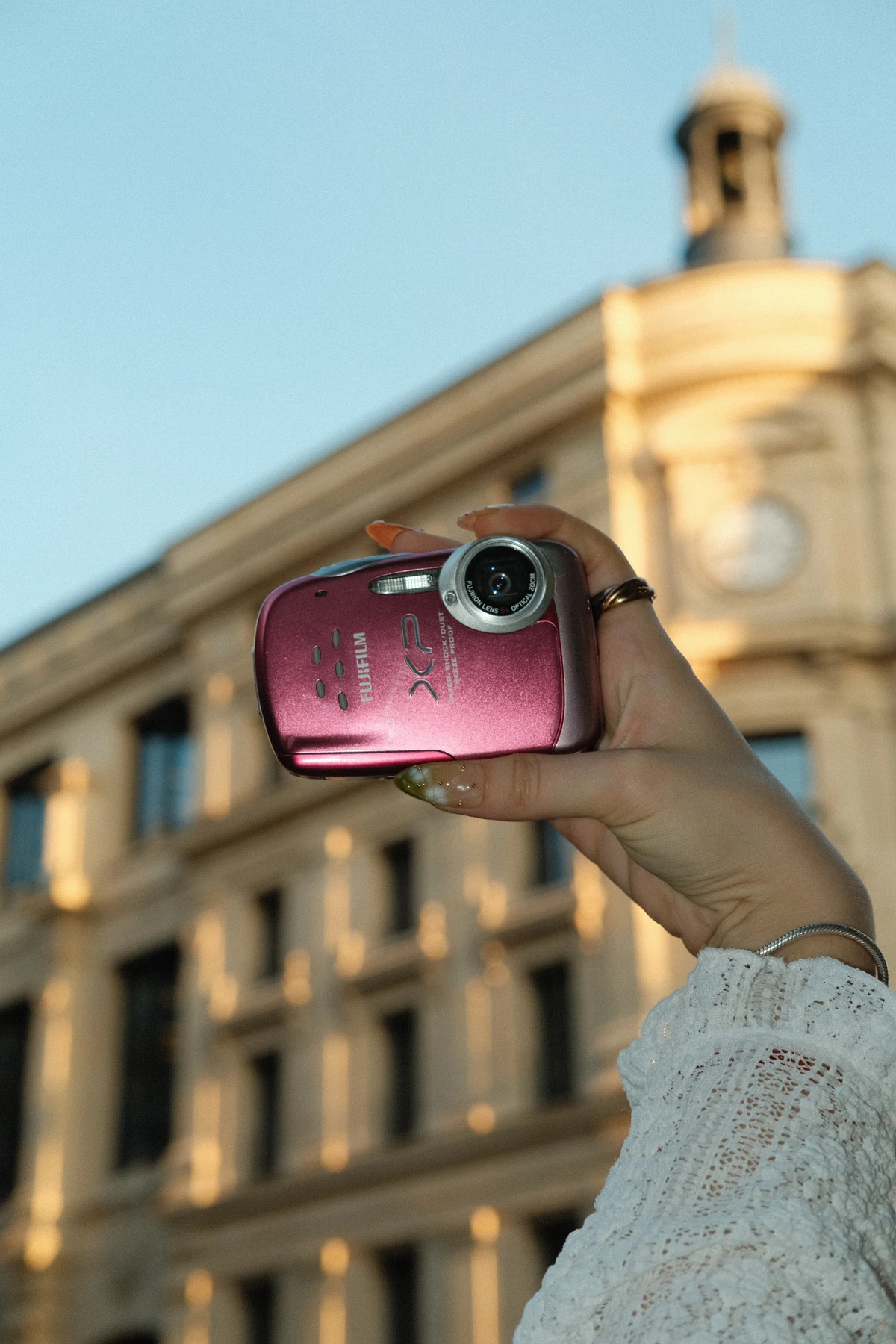
A camera designed to end up in the water
The XP15 belongs to that family of cameras Fujifilm built to be mistreated. It’s written on the body, plain as day: water, shock, dust, freeze proof. Waterproof to three metres, able to survive a drop of one and a half metres, unaffected by sand and cold.
That specification explains everything else. The lens never extends from the body: the zoom works behind a fixed window, otherwise waterproofing would be impossible. The controls are large, well spaced and usable with wet fingers. And the aperture remains modest, around f/4, because a fast lens unit in a sealed body of this size simply didn’t exist at this price.
In other words, it’s a daylight camera. The interesting question is how far you can push it before it shows.
What the spec sheet says, what the files say
| Sensor | 12 megapixels (4000 × 3000 px files) |
|---|---|
| Lens | Fujinon 5×, 36–180 mm equivalent |
| Recorded aperture | f/4 at wide angle, f/4.5 at around 60 mm |
| ISO settings used that day | ISO 100 to 800 |
| Screen | 2.7 inches, anti-reflective coating |
| Waterproofing | 3 metres |
| Drop resistance | 1.5 metres |
| Video | 720p |
| Shooting aids | face and smile detection |
When you open the photos, the metadata reports a FinePix XP10 and not an XP15. It’s neither a mistake nor a mislabelled camera: the XP15 is part of Fujifilm’s XP10 series and shares its firmware. The installation CD supplied with the camera at the time even says ‘FinePix XP10 Series’. If you buy a second-hand XP15 and the software shows XP10, all is well.
On cameras that have sat in a drawer for years, the backup battery has died and the clock resets to its factory date. The eight photos from this walk are dated January 2010, even though they were taken this summer. It doesn’t change the image, but it makes sorting impossible. Two minutes in the menu the first time you switch it on will save you that.
The walk, hour by hour
Late afternoon: where it has nothing to prove

At this time of day, it has everything it needs. The low-angle light picks out the mouldings, the sky stays blue instead of turning grey, and the stone keeps the warm tone it really has. Colours come out bold, a little strong in the reds: that’s the signature of this generation of compacts, and it’s exactly what many people come looking for today.
At ISO 100 and 1/170 s, the file is clean. Viewed at screen size, nothing gives away the camera’s age.
Under the glass roof: where the dynamic range runs out

A covered arcade means harsh backlighting: sky filling the frame on one side, shaded stone on the other. The XP15 makes a choice, and makes it decisively: it holds the sky and gives up on the shadows. The bas-reliefs and mouldings around the edge become silhouettes.
This is the camera’s most visible limitation. With a sensor of this size and era, there’s no latitude to recover in the shadows: what’s black is lost. It’s up to you to pick your side when you take the shot, by aiming at the area you want to keep.
Dusk: the shutter speed starts to drop


Left: ISO 200, f/4.5 at 60 mm, 1/17 s. Right: ISO 200, f/4, 1/27 s.
The terraces arrive just as the camera starts to struggle. It goes up to ISO 200 and lets the shutter speed slide: 1/27 s, then 1/17 s as soon as you zoom in a little. At those speeds, handheld and without effective stabilisation, camera shake is no longer just a risk.
The photo on the left stays sharp because the scene is still and the camera was held steady. The one on the right already shows that slight softness that gives the hand away. It’s not necessarily a flaw (plenty of people like that texture), but it’s better to know about it than to be caught out by it.
At night: grain, halos and neon

A quarter of a second handheld, at ISO 800. On paper, it’s a lost photo. In practice, it holds up: the street lamp bursts into a star, the fairy lights bleed a little, the Virginia creeper turns dark red. It’s noisy, it’s soft in the corners, and it’s exactly the look this generation of compacts produces at night.

Illuminated signs suit it much better. When the scene contains its own light source, the camera drops back to ISO 100, the shutter speed goes up, and the neon keeps its colour instead of bleeding into white. That’s the best night-time use for this camera: aim at what glows, not at what’s lit.


Two ways to handle the night: let black be black, or go with a coloured light.
The dark street shows the same thing as the glass roof, in reverse: anything that isn’t directly lit disappears into black. The green shop window, on the other hand, is the nice surprise of the evening: faced with heavily saturated artificial light, the white balance doesn’t panic and lets the colour cast show instead of half-correcting it.
What it does well, what it doesn’t
Its strengths
- Bold, warm colours in daylight
- A sought-after “digicam” look, with no filter or editing
- A camera you don’t have to worry about: water, sand, drops
- No lens sticking out: nothing to break in a pocket
- 12 MP files, plenty for screens and everyday prints
Its limits
- Limited dynamic range: shooting into the light, the shadows are lost
- A modest aperture that makes the shutter speed drop as soon as dusk falls
- Visible noise from ISO 400
- A zoom that costs a lot of light beyond wide-angle
- A 2.7-inch screen that isn’t precise enough to judge sharpness on the spot
Who it’s for
For anyone who wants a camera they can take where they wouldn’t dare get their phone out: the sea, the pool, a festival in the rain, a hike. That’s its territory, and on that territory nothing at this price comes close.
For anyone after the look of 2010s digital compacts, too: that slightly heavy colour, that grain, those halos around lights. If that’s what draws you, have a look at the rest of our second-hand digital compacts, and our review of the Fujifilm FinePix AV100, from the same maker, in an even simpler vein.
On the other hand, if you mostly shoot indoors or at night, give it a miss: it’s not a question of skill, it’s a question of aperture and sensor.
Five tips to get the most out of it
- Set the date the first time you switch it on. Otherwise your files will be dated 2010 and impossible to sort.
- Shoot before nightfall. The hour before sunset is when this camera is at its best.
- Move closer rather than zooming. At wide-angle it opens to f/4. At the long end of the zoom you lose light and sharpness.
- Steady yourself. A wall, a table, a railing: below 1/30 s, that’s what makes the difference between a photo and a blurry memory.
- Rinse it in fresh water after the beach and check that the hatch seal is clean before every swim. That seal, and that seal alone, keeps the water out.
How we checked it
This camera went over the workbench before heading out: we check power-on, zoom, screen, shutter release, flash, card reading and the condition of the seals. What we check on every piece is described in our testing method, and how we grade wear in conditions and guarantees.
All the photos on this page come straight off the card: no cropping, no colour correction, no noise reduction. They’ve only been converted to WebP so the page stays light to load.
More hands-on reviews like this? They’re gathered in the workshop journal. And if you have a compact from this generation sleeping in a drawer, we regularly buy them : tell us what you’ve got.
Frequently asked questions about the Fujifilm FinePix XP15
Is the FinePix XP15 really waterproof?
Yes, it’s a sealed camera, designed for the beach, the pool and dust. That brief explains the rest of its design, starting with a lens that never extends out of the body.
Why doesn’t its lens extend?
Because a lens that extends would let water in. The optics work behind a fixed window: that’s what makes it waterproof in the first place, and it also makes it tougher against sand.
Is it any good away from the beach?
That’s exactly what we wanted to find out by taking it round Paris. It gives a bold look in daylight. Late in the day and at night, you have to accept its limits and play with them.
What memory card does it need?
A card suited to its generation rather than a recent high-capacity card, which these cameras don’t always recognise. The format it takes is given on the product page. See our SD cards.